
Revenue Systems · CopyPower Media · March 15, 2026 · 11 min read
Most course creators spend thousands chasing better ads. The real leak is hiding somewhere else entirely.
The Quick Answer
Most webinar funnels fail because the transitions between stages of the webinar journey are not intentionally designed.
Registrants do not attend. Attendees leave before the pitch. Buyers never activate after purchase.
When these transitions are broken, conversion rates collapse — even when traffic and registrations are healthy. More registrants won't fix a broken pathway. Redesigning the transitions will.
What Course Creators Believe vs. What's Actually True
When webinar sales disappoint, the instinct is immediate and predictable:
"We need more registrants."
So founders increase ad spend, promote harder, test new audiences, and refresh creative — pouring money into the top of the funnel while the leak continues somewhere in the middle.
Traffic is visible and measurable. It feels like the problem because it's the thing you can most easily act on. But the breakdown almost never happens at traffic. It happens in the quiet, invisible handoffs between stages — the moments when a registrant decides whether to show up, when an attendee decides whether to stay through the pitch, and when a buyer decides whether to ever open the program they just purchased.
The Questions Founders Are Actually Asking
When course creators search for answers about failing webinar funnels, these are the real questions they're asking:
Why do people register for my webinar but not attend?
Why do attendees leave before the pitch?
Why do webinars convert for some creators but not for me?
Why do I get hundreds of registrants but only a few sales?
What's a good webinar attendance rate, and why am I below it?
Why do my buyers not engage with the course after purchasing?
Notice what these questions have in common. None of them are traffic questions. Every single one is a conversion pathway question — a question about what happens between stages, not at the top.
If you've been asking any version of these questions, you've already correctly identified where the problem lives. You just may not have had a framework to solve it yet.
The Webinar Revenue Pathway: A Framework for Diagnosis
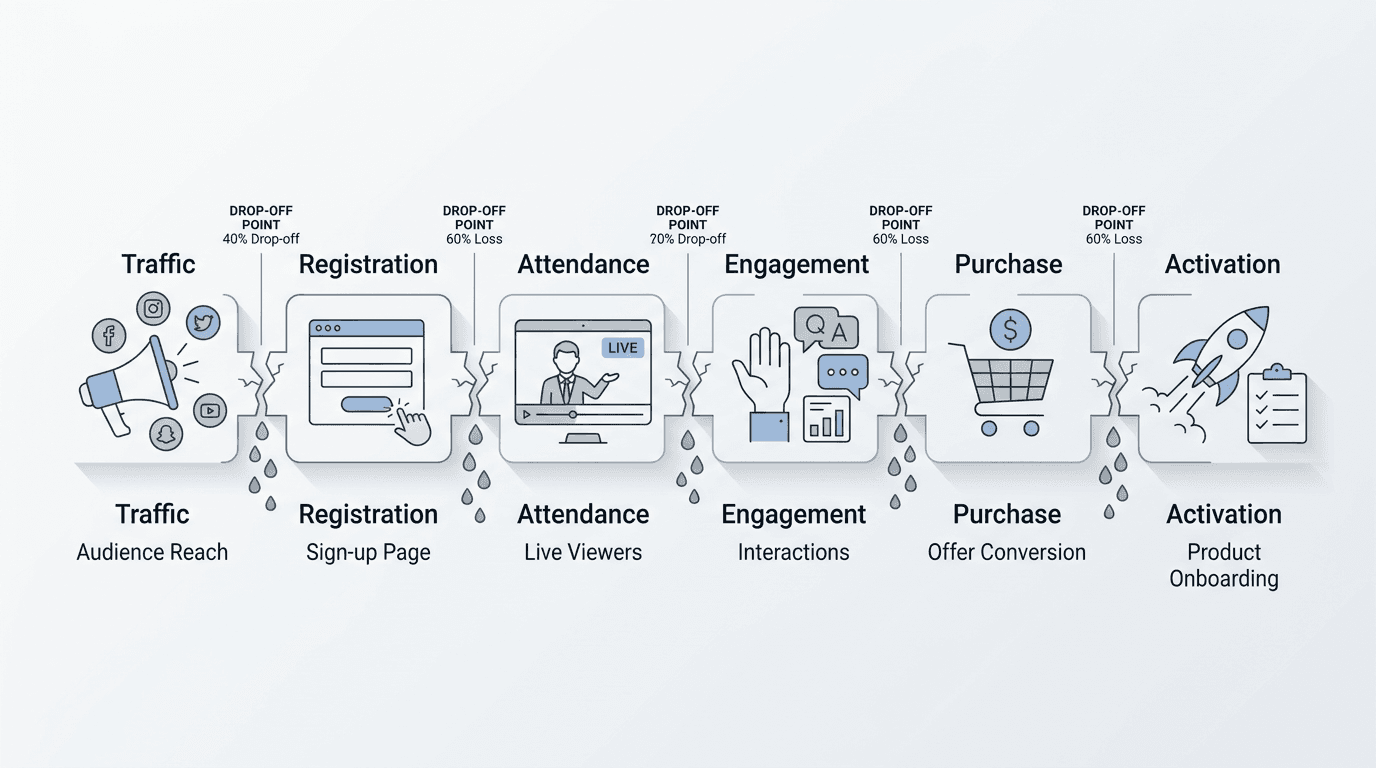
The Webinar Revenue Pathway is the sequence of transitions that move a prospect from registration to attendance, engagement, purchase, and activation.
Before you can fix a leak, you need to see the whole pipeline. Here is the complete pathway most course creators are running through — often without realizing it:
Revenue flows through each of these stages in sequence. A breakdown at any transition point limits everything downstream. You can have exceptional traffic and terrible revenue if the middle of this pathway is broken.
Let's walk through where funnels actually break — and why.
Where Webinar Funnels Actually Break
Stage 1: The Registration → Attendance Leak
This is the first place most funnels lose significant revenue, and it's almost always underestimated.
Industry benchmarks put average webinar attendance rates between 25% and 40%. That means at the high end, 60% of your registrants — people who raised their hand, filled out a form, and expressed interest — never actually show up.
Most course creators treat this as a fixed reality.
"That's just how webinars work."
It isn't. Low attendance rates are almost always a symptom of a broken confirmation and reminder system. When there is no meaningful re-engagement between registration and the event, registrants forget, deprioritize, or simply lose the emotional momentum that made them sign up.
A strong attendance system doesn't just remind people the webinar is happening. It rebuilds anticipation. It reminds registrants why they signed up and what they're about to learn. It makes showing up feel worth the time they're about to give you.
Common signs of a registration → attendance leak:
- Attendance rate below 30%
- Registrants who open reminder emails but don't join
- High registration volume with flat or declining attendance over multiple launches
Stage 2: The Attendance → Engagement Leak
Getting people on the webinar is only half the battle. The next transition is keeping them there long enough for the webinar to do its job.
Most webinars lose a meaningful percentage of their audience before the teaching segment ends — and almost certainly before the pitch begins. When you look at the drop-off data, you often find people leaving within the first 10 to 15 minutes, well before the transformation you promised them has had a chance to land.
Why does this happen?
The most common culprits are:
Weak opening framing — failing to clearly state what the attendee is about to learn and why it matters to them specifically
Slow pacing — too much backstory, too many credentials, too long before getting to the content people came for
Unclear expectations — attendees don't know the structure of the webinar, so they don't know whether to stay
A well-paced webinar front-loads value and uses framing to set expectations clearly. Attendees who know what's coming — and who understand the structure — are far more likely to stay through to the offer.
Common signs of an attendance → engagement leak:
- High attendance but low stay-through rate
- Attendees dropping off during the content (before the offer)
- Positive feedback about the webinar from people who stayed, but too few people staying
Stage 3: The Engagement → Purchase Leak
This is the transition most course creators obsess over — and, ironically, one of the places they have the least insight.
Attendees who stay engaged through the full webinar and never buy are experiencing one of three problems:
1. Weak offer transition. The shift from content to pitch feels jarring or salesy, creating psychological resistance even in people who want to buy.
2. The problem isn't fully crystallized. The best webinars don't just teach — they help the attendee see their own situation more clearly. If the problem hasn't been made vivid and specific, the offer to solve it lands without urgency.
3. Missing urgency. Not manufactured scarcity, but genuine, well-reasoned urgency. Why should someone decide now rather than later? If that question isn't answered in the webinar, most people default to "I'll think about it" — and never come back.
Common signs of an engagement → purchase leak:
- High stay-through rate with low conversion
- Lots of positive comments and questions during Q&A, then silence after the offer
- People asking for the replay link but not buying after watching
Stage 4: The Purchase → Activation Leak
This is the most overlooked revenue leak in online education — and one of the most consequential for long-term business health.
When a buyer purchases a course and never meaningfully engages with it, several things go wrong:
- They don't get results, so they can't give testimonials
- They have a higher likelihood of requesting refunds
- They are far less likely to buy again or refer others
- Word-of-mouth becomes neutral or negative instead of positive
Most course creators have no post-purchase activation sequence. The buyer gets access credentials and a generic "welcome" email — and then silence. The assumed next step is obvious to the creator but invisible to the buyer.
A strong activation sequence bridges the gap between purchase and first meaningful result. It reduces overwhelm, sets clear expectations, and guides the new student toward early wins that make continued engagement feel worthwhile.
Common signs of a purchase → activation leak:
- High refund rates
- Low engagement inside the course platform
- Few student testimonials or success stories despite many sales
A Real-World Example: Same Traffic, Nearly Double the Revenue
Here is a scenario that plays out regularly across course businesses:
A course creator launches a webinar funnel with:
- 1,800 registrations
- 32% attendance rate (576 attendees)
- 2.4% purchase rate (approximately 14 sales)
At first glance, the conclusion seems obvious: the traffic must be low quality, or the audience must be the wrong fit. The founder considers shifting ad targeting, testing new hooks, expanding to a new platform.
But a closer look reveals something different:
- Attendance reminders were a single automated email the morning of the webinar
- The webinar opened with 12 minutes of backstory and credentials before delivering any content value
- The offer transition included a price drop with no explanation of why the discount existed
- Post-purchase, buyers received login credentials and nothing else for the first two weeks
After redesigning each of these transitions — stronger re-engagement before the event, faster content delivery in the opening, a clearer and better-framed offer transition, and a structured activation sequence — the same traffic, the same audience, and the same webinar topic produced nearly double the revenue.
Nothing changed except the transitions.
Signs Your Webinar Funnel Has a System Problem (Not a Traffic Problem)
You may be dealing with a broken webinar revenue pathway if:
- Registrations look healthy but attendance is consistently low (below 30%)
- Attendees drop off before the pitch (high registration + attendance, low offer-view rate)
- Purchase rates fluctuate wildly between launches with no corresponding change in traffic quality
- Buyers fail to engage with the program within the first two weeks
- Refund rates are above 5% for a well-produced course
These are system signals. They are telling you the pathway is broken — not that the audience is wrong.
How Successful Course Creators Fix This
The shift in thinking is straightforward, but it requires letting go of the "more traffic = more revenue" equation.
Instead of asking
"How do we get more registrations?"
, successful course creators ask
"How do we guide each registrant through the journey?"
In practice, that means:
1. Building a real attendance system.
Not just reminder emails, but a pre-webinar sequence that rebuilds anticipation, addresses potential objections to showing up, and makes the act of attending feel worth prioritizing.
2. Designing the webinar with pacing in mind.
Front-loading value, setting clear expectations in the first five minutes, and structuring content so it naturally builds toward the offer without a jarring transition.
3. Crystallizing the problem before presenting the solution.
The offer should feel inevitable by the time it arrives — not because of pressure, but because the webinar has helped the attendee clearly see the cost of staying where they are.
4. Building an activation sequence after purchase.
A series of post-purchase touchpoints that welcome the buyer, set clear expectations, reduce overwhelm, and guide them toward their first meaningful win.
The webinar itself doesn't change. The pathway it sits inside does.
The Underlying Principle
Here's the truth that most course creators don't want to hear, because it's harder than running more ads:
Revenue is a result of pathway design, not traffic volume.
This is the same pattern that shows up across education businesses of every size: the problem isn't traffic, it's the revenue system connecting the stages of the customer journey.
If you haven't read Why Most Course Businesses Don't Have a Traffic Problem, that article establishes the broader thesis this piece builds on.
Traffic gets people to the door. Pathway design determines whether they walk through it, stay, buy, and come back. When the pathway is broken, more traffic just means more people experience the friction — and leave.
When the pathway is designed with intention, the same audience can produce dramatically different results.
This is why two course creators with nearly identical audiences, similar products, and similar ad budgets can have wildly different revenue outcomes. One has a working pathway. One doesn't.
What to Do Next
If you recognized your funnel in any of the stages above, the diagnostic work is straightforward:
1. Map your current pathway.
Write down your numbers at each stage: registrations, attendance rate, stay-through rate, conversion rate, and activation rate (how many buyers log in within the first 7 days).
2. Identify your biggest leak.
The stage with the steepest drop-off is your highest-leverage fix. Start there — not at traffic.
3. Redesign the transition, not the stage.
The content of your webinar isn't usually the problem. The systems around it — before, during, and after — are where the work lives.
The goal isn't a perfect funnel. It's a funnel where each transition is intentionally designed rather than assumed.
Ready to find out exactly where your funnel is leaking? Take the Revenue System Diagnostic and get a clear picture of which stage is costing you the most.
Related Questions This Article Answers
- Why is my webinar attendance rate so low?
- How do I increase webinar conversion rates?
- What is a good webinar show-up rate for course creators?
- Why are my webinar attendees not buying?
- How do I activate new course buyers after purchase?
- What causes low course engagement after purchase?
- Why does my course have a high refund rate?
- How do I fix a leaking webinar funnel without increasing ad spend?
Discover More Insights

Retention
Why Education Memberships Lose Students (And How to Fix It)
When a student cancels, most creators go straight to the same two suspects: the price was too high, or the content wasn't good enough. After working with enough membership businesses, I can tell you it's almost never either of those things.

Strategy
Why Most Course Businesses Don't Have a Traffic Problem
Most course businesses do not struggle because of traffic. They struggle because the pathway between stages of the student journey is incomplete. When the transitions between discovery, enrollment, engagement, and retention are not intentionally designed, revenue becomes unpredictable even if traffic is steady.
Strategy
The Hidden Revenue Between Course and Membership
How to design the transition most course creators leave to chance — and the recurring revenue it unlocks