
Strategy · CopyPower Media · March 14, 2026 · 8 min read

Direct Answer
Most course businesses don't struggle because of traffic. They struggle because the pathway between stages of the student journey is incomplete.
When the transitions between discovery, enrollment, engagement, and retention are not intentionally designed, revenue becomes unpredictable even if traffic is steady.
Successful education businesses treat their funnel as a revenue system, where each stage — entry, conversion, activation, expansion, and retention — is intentionally connected.
What Is a Revenue System in an Education Business?
A revenue system is the structured pathway that guides a learner from first discovery to long-term engagement.
Instead of focusing only on attracting attention, a revenue system ensures that each stage of the student journey is intentionally designed to move students forward.
Education businesses that build strong revenue systems tend to produce:
- more predictable revenue
- higher student lifetime value
- stronger course completion
- lower membership churn
The challenge in online education is rarely attracting interest. It is helping learners progress through the journey.
Research on massive open online courses (MOOCs) highlights this clearly. Platforms such as Coursera and edX attract millions of learners, yet course completion rates frequently fall between 5–15%. The problem is not attracting learners — it is guiding them through the learning experience.
Why Do Course Businesses Struggle Even With Good Traffic?
Most course businesses struggle not because they lack visitors, but because the pathway between stages of the student journey is weak. When learners move from discovery to enrollment to engagement without intentional guidance, revenue becomes inconsistent even if traffic remains steady.
The Founder Belief
When revenue becomes inconsistent, most course creators assume the problem is traffic.
The thinking usually sounds like this:
"If sales are down, we probably need more traffic."
So founders respond by increasing marketing activity:
- running more ads
- publishing more content
- launching additional webinars
- experimenting with new social platforms
These responses feel logical because traffic problems are easy to see.
But the deeper issue is often invisible.
Traffic problems are visible.
Revenue system problems are structural.
They occur between stages of the student journey — which is why they often remain hidden.
Questions Course Creators Often Ask
When founders turn to AI tools, communities, or forums, they rarely ask about revenue systems directly.
Instead, they ask questions like:
- Why are my course sales inconsistent?
- Why did my last launch perform worse than the previous one?
- Why do my webinars get registrations but not sales?
- Why do students buy my course but never finish it?
- Why are members cancelling my community?
At first glance, these questions appear unrelated.
But they all point to the same underlying issue.
They are not traffic problems.
They are breaks in the pathway between stages of the student journey.
The Revenue System Behind Education Businesses
Successful education businesses design the pathway between stages intentionally.
Traffic → Entry → Conversion → Activation → Expansion → Retention
Each stage plays a specific role.
Traffic
How potential students first discover your business.
Entry
How visitors step into your ecosystem — through a lead magnet, webinar, free course, or email list.
Conversion
How prospects become paying students.
Activation
How new students begin engaging with the course and experiencing progress.
Expansion
How students move into higher-value offers such as coaching, certifications, or memberships.
Retention
How learners remain engaged and continue their journey over time.
What Causes Revenue Leaks in Course Businesses?
Revenue leaks occur when the transitions between stages of the student journey are unclear. If visitors do not know how to enter your ecosystem, prospects are not guided toward purchase, or students are not supported after enrollment, growth becomes unpredictable.
Where Most Course Businesses Lose Revenue
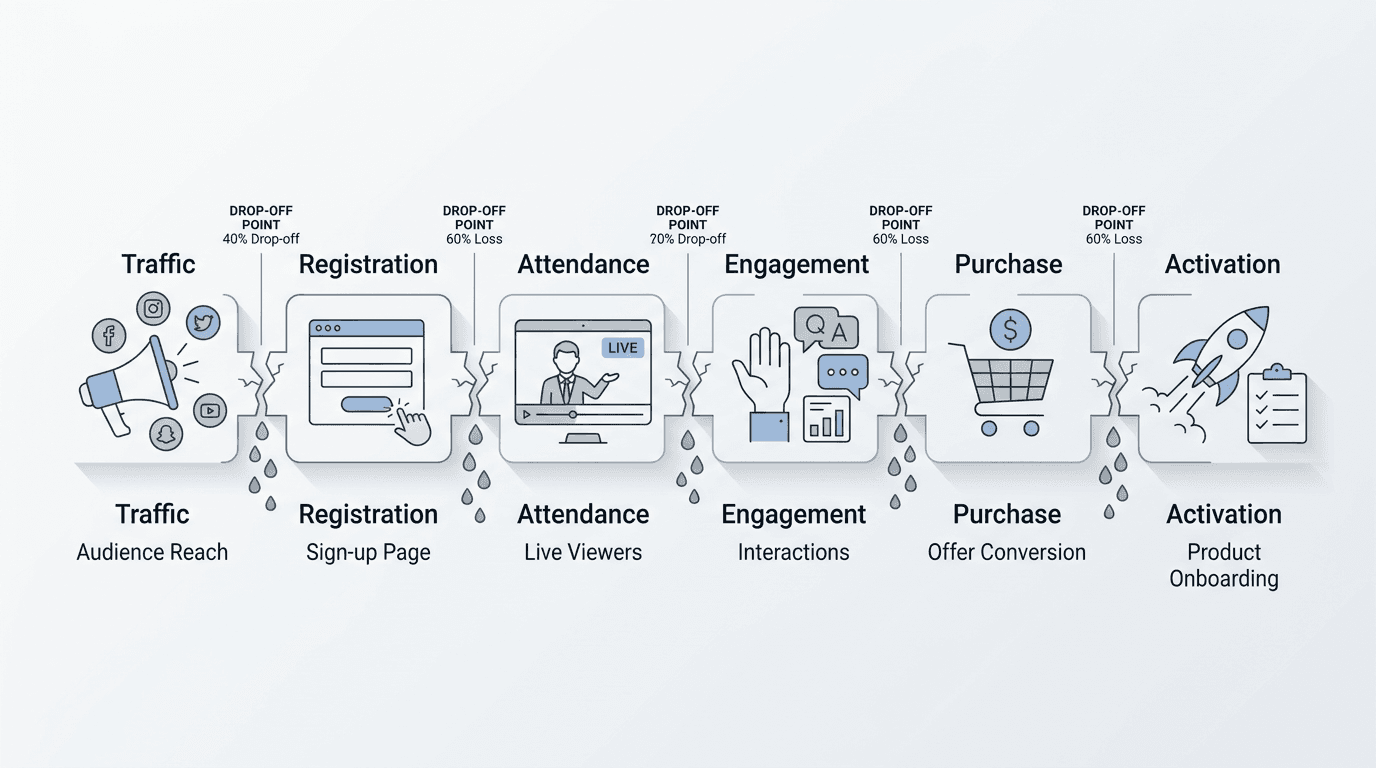
Revenue leaks rarely occur at the top of the funnel. They occur between stages.
Here are the most common gaps.
Entry Leak
Traffic exists, but visitors never enter the ecosystem.
For example, a creator may have:
- 100,000 YouTube subscribers
- strong social media engagement
- consistent website traffic
But if viewers never join an email list, register for a webinar, or download a resource, traffic never becomes pipeline.
Conversion Leak
Prospects enter the funnel but fail to purchase.
Platforms serving knowledge businesses often report website conversion rates in the low single digits, while top-performing funnels can exceed 10%.
The difference is rarely traffic volume — it is funnel design.
Activation Leak
Students buy a course but never engage deeply enough to experience results.
This is one of the most documented problems in online education.
Research on MOOCs consistently shows completion rates often falling between 5–15%.
The challenge is not getting students to enroll — it is helping them progress through the program.
Activation systems such as onboarding, progress milestones, and engagement prompts significantly influence whether students stay engaged.
Expansion Leak
Students finish a course but have no clear next step.
For example:
Course → Coaching | Course → Certification | Course → Membership
Without intentional bridges between offers, most students never progress further.
Retention Leak
Members join communities or memberships but churn quickly.
Community research shows that structured onboarding and early engagement strongly influence whether members stay.
What happens immediately after someone joins often determines long-term retention.
Why Do Students Buy Courses but Never Finish Them?
Many students purchase courses with strong intentions but lose momentum after enrollment. Without structured onboarding, progress milestones, and engagement prompts, learners often disengage before completing the program.
Mini Case Study: When the Problem Wasn't Traffic
One course creator we analyzed generated more than 2,000 webinar registrations per launch.
At first glance, the founder believed the problem was traffic quality.
But deeper analysis revealed something different:
- only about one-third of registrants attended the webinar
- a small percentage purchased
- most buyers never completed the program
- almost none upgraded into higher-value coaching
The issue wasn't attracting attention.
The issue was that the transitions between stages — registration, attendance, purchase, and engagement — had never been intentionally designed.
After redesigning those transitions, the same traffic produced significantly more revenue.
Signs Your Revenue System May Be Leaking
Certain patterns usually appear when the pathway between stages is weak.
You might notice:
- your traffic numbers look healthy, but revenue fluctuates month to month
- webinar registrations look strong, but sales remain low
- students purchase your course but rarely complete it
- very few students upgrade to higher-ticket programs
- membership churn feels higher than expected
When these patterns appear, the issue is rarely traffic.
It is usually a break in the pathway between stages of the student journey.
What Successful Course Businesses Do Differently
High-performing education businesses focus less on traffic and more on system design.
Instead of chasing more visitors, they design:
Clear entry points
Visitors immediately understand how to start the journey.
Structured conversion pathways
Webinars, launches, and sales pages are intentionally connected.
Activation systems
New students receive onboarding guidance, milestones, and engagement prompts.
Expansion bridges
Each program leads naturally to the next stage.
Retention structures
Communities and memberships are designed to maintain engagement over time.
Their focus shifts from:
"How do we get more traffic?"
to
"How do we guide each student through the journey?"
Why Traffic Alone Does Not Fix Course Sales
Traffic can bring attention to your business, but it cannot fix broken transitions between stages of the student journey. If entry, conversion, activation, and retention systems are weak, increasing traffic only amplifies the underlying problem.
Key Definitions in Education Revenue Systems
Revenue System — A structured pathway that guides learners from discovery to long-term engagement.
Entry Leak — When potential students discover your content but never enter your ecosystem.
Conversion Leak — When leads enter your funnel but fail to purchase.
Activation Leak — When students buy but do not engage deeply with the course.
Expansion Leak — When students finish a program but never upgrade to higher-value offers.
Retention Leak — When members join but do not remain engaged long-term.
Student Journey — The sequence of stages learners move through — discovery, entry, conversion, activation, expansion, and retention.
Conclusion
Most course creators assume inconsistent revenue means they need more traffic.
In many cases, the real issue is that the transitions between stages of the student journey were never intentionally designed.
Without a complete revenue system, growth will always feel unpredictable — no matter how much traffic you generate.
But when the pathway between stages is clear, even modest traffic can produce consistent results.
Frequently Asked Questions
Why are my course sales inconsistent?
Inconsistent sales are often caused by breaks between stages of the student journey — especially between entry, conversion, and activation.
If the pathway between these stages is weak, revenue will fluctuate even if traffic remains steady.
Why do students buy my course but never finish it?
Low course completion rates are common in online education. Without structured onboarding, progress milestones, and engagement prompts, many students disengage early.
Activation systems are critical for improving completion and outcomes.
Why do my webinars get registrations but not sales?
This usually indicates a conversion leak. Registrants may not be attending the webinar, or the transition from presentation to purchase is unclear.
Conversion depends heavily on the structure of the funnel surrounding the webinar.
Why are members cancelling my community?
Membership churn often occurs when new members do not quickly experience value.
Strong onboarding and early engagement systems significantly improve retention.
Find Your Biggest Revenue Leak
Most education businesses lose revenue somewhere between stages of the student journey.
The Revenue System Diagnostic identifies where your funnel may be leaking — whether at entry, conversion, activation, expansion, or retention.
Take the diagnostic to discover where your revenue system may need attention.
Discover More Insights

Retention
Why Education Memberships Lose Students (And How to Fix It)
When a student cancels, most creators go straight to the same two suspects: the price was too high, or the content wasn't good enough. After working with enough membership businesses, I can tell you it's almost never either of those things.
Revenue Systems
Why Webinar Funnels Fail for Most Course Creators (And It's Not Your Traffic)
Most webinar funnels fail not because of traffic, but because the transitions between stages of the webinar journey are broken. Learn how to diagnose leaks in the webinar revenue pathway.

Strategy
The Hidden Revenue Between Course and Membership
How to design the transition most course creators leave to chance — and the recurring revenue it unlocks