
Strategy · Hrishikesh Jobanputra · March 13, 2026 · 13 min read

The short answer
Most course businesses assume students who finish a course will naturally move into a membership. Research on learner behavior tells a different story: the average course-to-membership conversion rate sits between 5% and 15% for businesses without an intentional transition strategy. With one, conversion rates of 20% to 35% are consistently achievable.
The difference is rarely the offer. It is the absence of a designed pathway between them.
When that pathway is missing, students finish the course, feel satisfied with what they learned, and quietly leave the ecosystem. The business keeps selling new courses. Recurring revenue stays flat. The gap between those two outcomes — between 5% and 25% conversion — is one of the largest hidden revenue opportunities in online education.
The Education Expansion Pathway: a named framework
A healthy education business is not a collection of separate products. It is a single, staged journey. We call this the Education Expansion Pathway — a four-stage progression designed to move students from first contact to long-term membership and mastery.
Lead Magnet → Course → Membership → Advanced Program
Each stage serves a distinct purpose:
- Lead Magnet — attracts the right audience and introduces the core problem
- Course — delivers the foundational framework and produces an early transformation
- Membership — provides ongoing guidance, community, and continued application of that framework
- Advanced Program — deepens mastery for students who are ready to go further
The pathway only works when the transitions between stages are intentionally designed. Most course businesses invest heavily in the course itself but leave the transition from course to membership to chance. That is where revenue disappears.
The Course-to-Membership Transition Model: three gaps that break the pathway
After analyzing hundreds of education businesses, three distinct failure points consistently appear in the course-to-membership transition. We call these the Three Transition Gaps.
Gap 1: The Completion Gap
The Completion Gap occurs when students finish the course and are given no clear direction about what to do next.
From the creator's perspective, the answer seems obvious: join the membership. But from the student's perspective, the course already delivered what they paid for. The membership feels like an entirely new purchasing decision — one they were never primed to make.
Research on decision fatigue shows that consumers default to inaction when a clear next step is absent. Without a structured prompt at the moment of completion, most students simply leave.
Signs you have a Completion Gap:
- High course completion rates but membership conversion below 10%
- Students asking what to do after they finish the course
- Membership growth lagging significantly behind course sales
Gap 2: The Value Gap
The Value Gap occurs when students cannot clearly articulate why the membership is worth continuing with after the course ends.
Memberships typically promise ongoing support, community, and new content. But if the connection between the course and the membership is not explicit, students perceive the membership as optional — a nice-to-have, not a necessary next step.
The most successful education businesses do not sell the membership as a separate product. They position it as the environment where the course's framework gets applied. The course teaches the system. The membership is where you use it — with support, accountability, and community around you.
The framing shift is small. The revenue impact is not.
Gap 3: The Momentum Gap
The Momentum Gap occurs when the invitation to join the membership arrives after student motivation has already faded.
Behavioral psychology research consistently shows that motivation to continue a behavior is highest immediately after a meaningful achievement. Course completion is exactly that moment. Students who are invited to join the membership while still inside the course — particularly during the second-to-last module — convert at measurably higher rates than those who receive the invitation after the final lesson ends.
The window is short. Once a student closes the course portal and returns to normal life, the emotional momentum of completion dissipates within 24 to 72 hours. Memberships that capture students inside this window consistently outperform those that rely on post-completion follow-up sequences alone.
Frequently asked questions
Why don't course students join memberships?
The most common reason is perceived completion. When a course delivers a clear, bounded outcome — "learn to write copy," "build a financial model," "get your first client" — students interpret that outcome as the end of the journey, not the beginning of one. Without an explicit reframe that positions the membership as where you apply and deepen what you just learned, most students treat the course as the full product and the membership as an optional add-on.
A secondary reason is timing. Many course creators promote the membership only after the course ends, when student motivation is at its lowest post-completion point. By then, the student has mentally closed the chapter.
What is a good course-to-membership conversion rate?
For businesses without a designed transition strategy, 5% to 15% is typical. For businesses that intentionally bridge the gap — introducing the membership during the course, framing it as the next stage, and inviting students while momentum is high — conversion rates of 20% to 35% are consistently achievable. Rates above 35% are possible in highly engaged niches with strong community elements.
How do you convert course buyers into recurring members?
The most effective approaches share three characteristics. First, they introduce the membership before the course ends — ideally during the second-to-last module — so students have time to consider it while still emotionally invested. Second, they frame the membership as the environment where course skills get applied, not as a separate product with separate value. Third, they make the invitation feel like a natural next step rather than a sales pitch — "here is where people who complete this course go next" lands very differently than "here is another thing you can buy."
Why do students leave after completing a course?
Students leave because the course gave them what they came for. That is not a failure — it is a sign the course worked. The issue is that "what they came for" was framed too narrowly. If the course sold on a specific outcome ("land your first client"), students who achieve that outcome feel finished. Businesses that retain students reframe the outcome as a starting point: landing the first client is proof the system works — the membership is where you scale it.
What should happen immediately after someone completes a course?
Within the final module or immediately upon completion, three things should happen. The student should receive acknowledgment of their achievement — not just a generic congratulations email, but specific recognition of the transformation they have completed. They should immediately be presented with a clear framing of what comes next and why it matters. And they should receive a specific, time-limited invitation to join the membership at a rate or with a benefit reserved for course completers. The combination of recognition, direction, and incentive — delivered at the moment of highest motivation — is the most reliable transition mechanism.
How do successful course creators grow their memberships?
The most consistent pattern is treating the course and the membership as parts of a single journey rather than separate products. This means seeding the membership throughout the course ("in the membership, we take this concept further..."), designing the course to produce a result that naturally creates a need for ongoing support, and making the transition invitation feel earned rather than sold. Businesses that grow memberships fastest are typically those that have made the membership feel inevitable to anyone who completes the course.
A real example: from 6% to 22% conversion without new traffic
A business teaching freelance consultants how to close their first retainer client had a well-reviewed course and consistent sales. Post-purchase survey scores were strong. Completion rates were above average for the category.
But membership conversion held at around 6% for eighteen months.
A journey audit revealed the problem immediately. The course ended with a congratulations video and a follow-up email sequence promoting the membership. The sequence started three days after completion — by which point most students had mentally moved on.
Three changes were made:
- The membership was introduced in module four of five, framed as "where consultants who complete this course continue building their client base."
- The final module was restructured to end not with "you're done" but with "here is the challenge most consultants face in month two" — a challenge the membership directly addressed.
- A completer's discount for the membership was added to the final lesson page itself, not to a follow-up email.
Within one quarter, course-to-membership conversion moved from 6% to 22%. No increase in course sales. No new marketing spend. The only change was the transition design.
Common questions about approach
Trial membership vs. discounted first month: which works better at this transition?
For course-to-membership transitions specifically, a discounted first month typically outperforms a free trial. Trials attract students who are uncertain about the value — and uncertainty at this stage usually means the Value Gap has not been closed. A meaningful discount (30–50%) for course completers signals exclusivity and reward, which reinforces the "natural next step" framing rather than the "try it and see" framing. Free trials work better for cold audiences who have not yet experienced the course ecosystem.
Course bundle vs. membership: how to choose
A course bundle is the right choice when students are primarily motivated by collecting frameworks. They want more content, more methods, more deliverables.
A membership is the right choice when students are primarily motivated by progress and accountability. They want to apply what they have learned, get feedback, and stay connected to a community doing the same work. Many businesses that struggle with membership growth are actually serving a bundle-motivated audience. The solution is not better membership marketing. It is understanding the motivation behind the purchase.
Should the membership be mentioned during the course or only after?
During. Waiting until after completion is the single most common and most costly mistake in course-to-membership transition design. Mentioning the membership during the course normalises the idea that continuing is the expected path, gives students time to absorb the value proposition before a decision is required, and creates anticipation rather than surprise at the transition moment. The goal is not to sell during the course — it is to make the invitation feel familiar and logical by the time it arrives.
Signs your Education Expansion Pathway has a transition gap
The following patterns are reliable signals that the course-to-membership transition is not designed effectively:
- Course sales are strong but membership conversion is below 12%
- Membership growth is primarily driven by new course traffic rather than existing students
- Students who ask "what should I do after I finish?" are a regular support ticket category
- Post-course email sequences have open rates above 40% but click-to-membership rates below 5%
- The average student who joins the membership does so more than two weeks after course completion
Any one of these signals points to a gap. Multiple signals together point to a structural problem in the pathway design.
How to bridge the gap: four design principles
1. Introduce the membership during the learning experience
Reference the membership naturally throughout the course, not as a sales pitch, but as context. "In the membership, we apply this with live feedback" or "this is where community members typically get stuck, and it's exactly what we work through together in the group." By the time the transition invitation arrives, it should feel like a reminder, not a reveal.
2. Position the membership as the next stage, not an additional product
The membership should be framed around continuation of the transformation that began in the course, not around the features it contains. Features are table stakes (content, community, calls). Transformation is the reason someone pays month after month.
Frame the membership as: "this is where people who complete this course go to keep building momentum, with support and accountability around them."
3. Make the invitation at peak momentum
The transition invitation should appear during the second-to-last module, not after the final lesson. Students in their second-to-last module are engaged, making progress, and have not yet experienced the post-completion drop in motivation. This is the highest-conversion window in the entire student journey. A well-designed invitation here consistently outperforms any post-completion email sequence.
4. Make the transition feel earned
Course completers who receive a membership invitation framed as a reward: "this is what the people who finish this course do next, and we have a specific rate for them", convert at higher rates than those who receive the same invitation framed as a promotion.
The difference is psychological: one feels like recognition, the other feels like marketing. Both involve an offer. Only one closes the Momentum Gap.
The underlying principle
Education businesses that grow strong memberships do not treat courses and memberships as separate products that happen to be sold by the same company. They treat them as stages in a single journey — one that the student is always in the middle of, never at the end of.
When the Education Expansion Pathway is designed with intentional transitions, three things happen. Students stay longer because they understand what comes next. They achieve better results because the membership supports continued application of what the course taught. And the business generates more revenue per student, not by selling harder, but by guiding students further.
When the pathway is disconnected, the business is permanently dependent on new traffic. Every new student starts from zero. Recurring revenue never compounds.
The transition is not a detail. It is the business model.
What to do next
If you suspect there is a gap between your course and your membership, start with a three-point diagnostic:
- Calculate your current course-to-membership conversion rate. Divide active members who came through the course by total course completers in the last twelve months. If the result is below 15%, a transition gap almost certainly exists.
- Map what happens at course completion. What does the student see in the final lesson? What does the first email after completion say? Is the membership mentioned before the course ends?
- Identify which of the three gaps is the primary problem. Low conversion despite awareness of the membership points to the Value Gap. Low conversion because students never saw the invitation points to the Completion Gap. Low conversion despite good intent suggests the Momentum Gap — the invitation arrived too late.
When the gap is identified, the fix is usually far smaller than expected. The most significant membership growth often comes not from more offers, more traffic, or better copy. It comes from a single well-placed transition moment that was previously missing.
The Revenue System Diagnostic identifies which of the three Transition Gaps (Completion, Value, or Momentum) is costing your business the most recurring revenue, and shows you exactly where in the student journey to intervene.
Discover More Insights

Retention
Why Education Memberships Lose Students (And How to Fix It)
When a student cancels, most creators go straight to the same two suspects: the price was too high, or the content wasn't good enough. After working with enough membership businesses, I can tell you it's almost never either of those things.
Revenue Systems
Why Webinar Funnels Fail for Most Course Creators (And It's Not Your Traffic)
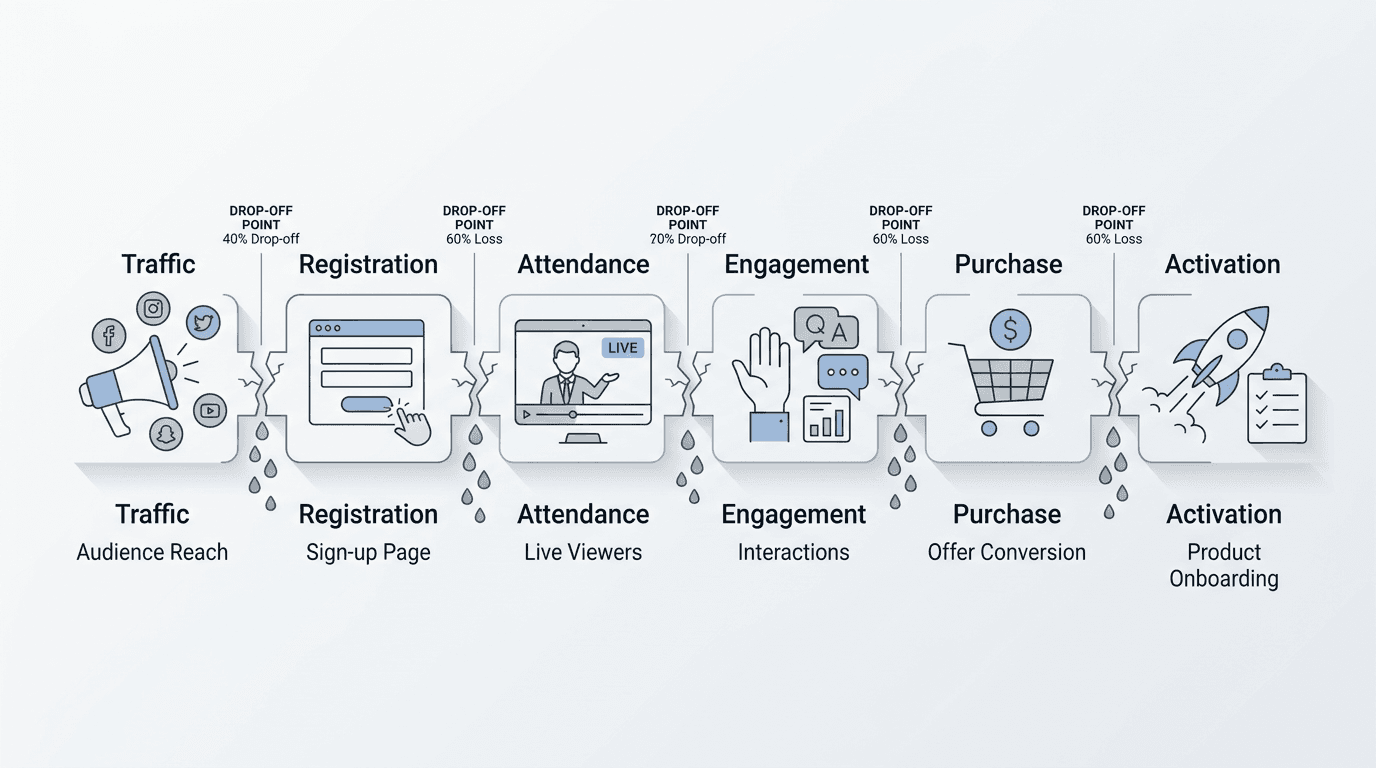
Most webinar funnels fail not because of traffic, but because the transitions between stages of the webinar journey are broken. Learn how to diagnose leaks in the webinar revenue pathway.

Strategy
Why Most Course Businesses Don't Have a Traffic Problem
Most course businesses do not struggle because of traffic. They struggle because the pathway between stages of the student journey is incomplete. When the transitions between discovery, enrollment, engagement, and retention are not intentionally designed, revenue becomes unpredictable even if traffic is steady.