
Retention · Hrishikesh Jobanputra · March 15, 2026 · 16 min read

When a student cancels, most creators go straight to the same two suspects: the price was too high, or the content wasn't good enough. After working with enough membership businesses, I can tell you — it's almost never either of those things.
The real culprit is usually sitting right in the middle of the member experience, invisible until you know what to look for.
Let's start with the uncomfortable truth
Your students aren't leaving because they don't like you. They're leaving because they lost their sense of direction.
They joined with a specific goal in mind. They dove into the content. Maybe they got a quick win or two. And then, somewhere around week six or month three, the momentum quietly died. Not dramatically. No big complaint. Just a gradual drift toward the cancel button.
Here's what that drift actually looks like inside a membership: a student logs in less frequently, participates less, eventually stops opening the emails. By the time they cancel, the decision was made weeks earlier. You just didn't see it coming because there was nothing obvious to see.
This is a structural problem. And structural problems don't get fixed by adding another course.
What the data tells us
The research on membership churn is more specific than the "content vs. price" debate suggests.
Cancellation risk peaks between days 30 and 90. Members who make it to day 91 while still actively engaged are far more likely to stick around for 12 months or longer. That window — the first three months — is where memberships are won or lost, and most creators spend almost no time designing it deliberately.
Week one matters more than any other single week. Members who take at least one meaningful action in their first seven days — posting in the community, completing a lesson, showing up to a live call — retain at dramatically higher rates than those who don't. Well-run memberships hit week-one activation rates of 40 to 60 percent. Memberships with no real onboarding often sit below 20.
More content doesn't automatically mean better retention. A membership with 500 lessons doesn't outperform one with 50 if members don't know which lesson to tackle next. What actually drives retention is clarity — the member's ability to answer "what should I do today?" without having to think hard about it.
Community participation predicts retention better than content consumption. A member who has posted, been replied to, and made a connection is far stickier than one who quietly works through modules alone. The content is the reason they joined. The community is the reason they stay.
And price — the reason people give when they cancel? Exit surveys over-report it because it's easy to say and requires no further conversation. When you follow up weeks later, or dig into the real pattern, the underlying reasons are almost always about feeling stuck, feeling lost, or feeling like a stranger in a community they never really connected with.
Why students actually leave: the psychology
To fix churn, you need to understand what's happening in a student's head before they cancel — not at the moment they do.
They think they're done when they're not
This is the one I see most often. A student joins, completes the beginner modules, gets their first win, and quietly concludes: I've done this. Not consciously. They don't think "I'm finished here." They just stop coming back.
The advanced content they need is often already in the membership. But no one made it visible. No one said "now that you've done X, here's where you go next." So the student fills in that silence with their own conclusion — which is that there's nothing left for them.
The plateau gets misread as failure
Every learner hits a plateau. After the fast early gains, progress slows down. This is completely normal and happens to everyone — but most memberships don't talk about it, and most students aren't expecting it.
So when the plateau arrives, the student doesn't think "ah, this is a natural phase of skill development." They think "this isn't working for me." They pull back. They disengage. And when they're disengaged, a $50 monthly charge starts to feel unjustifiable.
Memberships that name the plateau explicitly — that say "here's what this phase feels like, here's why it's happening, here's how to push through it" — see meaningfully lower churn in the three-to-six month range. Sometimes just naming the thing is enough.
They never found their people
There's a threshold in community belonging. Once a member has formed two or three real connections inside a community — people who know their name, who respond to their posts, who they'd miss if they left — they're very hard to lose. Below that threshold, they're just a subscriber. Easy to cancel, nothing tying them here.
The problem is that most memberships leave connection entirely to chance. You open the doors, add people to a group, and hope they find each other. Some do. Most drift through as strangers and eventually leave as strangers.
The investment starts working against you
Creators assume that sunk cost keeps members around — they've paid, so they'll stay. Sometimes that's true. But there's a flip side. A member who has invested four months of time and money and still doesn't feel like they've made real progress starts to see that investment as proof the membership isn't working. The longer they stay without a clear win, the more pressure builds to cut their losses.
This is why early wins matter so much. A student who gets a tangible result in week two has a completely different relationship with the membership than one who has been consuming content for two months and has nothing to show for it. One feels the investment is paying off. The other is doing the math on their credit card statement.
The three places retention breaks down
Think of a well-run membership as a pathway with distinct stages. Students don't just join and stay — they move through the experience, and there are three specific places where that movement stops.
Gap one: from joining to engaging
The most immediate failure point. A new member pays, gets access, and is immediately confronted with a library of content and no clear direction. They browse around, bookmark a few things, maybe watch one video — and then life gets in the way and they never come back.
This isn't about motivation or interest. It's about friction. When a new member has to decide what to do first, most will default to doing nothing. The answer to that is simple: remove the decision. Tell them exactly where to start.
Signs this is your problem: your new members are quiet. Nobody is posting or introducing themselves. Engagement drops off hard in week two.
Gap two: from engaging to progressing
This one is sneakier. These members did engage — they showed up, participated, maybe even became regulars. But then the momentum faded. Without visible milestones or a sense of forward movement, the membership starts to feel like a conversation rather than a journey. It's enjoyable, but optional.
The student starts skipping weeks. Then months. Eventually they're only opening the emails when something specific catches their eye. And then they cancel, almost as an afterthought.
Signs this is your problem: you see activity, but it's the same small group of people. Discussions happen but don't lead anywhere. Members consume without applying.
Gap three: from progressing to staying
This one hits your best students. They've done the work, they've gotten results, they've grown. Now they're asking an honest question: is there still something here for me?
If your membership was built around beginner and intermediate content, that question will eventually have an honest answer: not really. And when it does, even your most enthusiastic members will leave — not because they're unhappy, but because they've outgrown the experience.
Signs this is your problem: your churn spikes after month six. Exit feedback is warm and appreciative. Your most active members quietly disappear.
What to actually do about it
Each gap has its own set of fixes. The key is diagnosing which one is costing you the most before piling on tactics.
Fixing the join-to-engagement gap
Give new members one clear starting point. Not a welcome video that points to 47 modules. One thing. A "Start Here" challenge, a structured first-week path, a short onboarding sequence with a specific task on day one. The goal is a single low-friction action that establishes the habit of participation before the novelty wears off.
Ask a question on day one. Send a personal message — or an automated one that reads like a personal message — that asks something specific: "What's the one thing you're most hoping to get from this?" Don't deliver information. Ask something. Questions create replies, and a member who has replied once is more likely to come back.
Try cohort starts. Instead of rolling admissions with immediate open access, group new members together by intake month and introduce them to each other. Even a loose version of this — a monthly "welcome thread" with everyone who joined that month — creates early peer connection that wouldn't otherwise happen.
Fixing the engagement-to-progress gap
Make progress visible. Members should be able to see where they are at a glance — not buried in a spreadsheet or a hidden backend dashboard, but right there in the experience. A curriculum roadmap, a skills framework with levels, a simple progress tracker. It doesn't need to be elaborate. It needs to exist.
Build a recurring participation structure. A weekly challenge, delivered on the same day, with a clear deliverable and a place to share results, creates a rhythm of engagement that operates independently of motivation. A member who wouldn't choose to open the content library on a slow Thursday will still complete a short, well-scoped challenge. Predictability lowers the activation barrier.
Close the gap between learning and doing. Most memberships have a consumption problem: members watch, listen, read — but don't apply. Structured implementation prompts that ask members to use what they've learned in their real situation, then share what happened, create the kind of tangible outcomes that justify a membership fee far better than another video ever could.
Run live sessions, even short ones. A regular live call does two things at once: it gives members a specific reason to show up on a specific day, and it generates ongoing community content — recordings, discussions, shared takeaways — that makes the membership feel richer over time without requiring more content creation.
Fixing the progress-to-retention gap
Build something for your advanced members. This doesn't have to be a full second curriculum. An advanced monthly call, a challenge series designed for people who've done the basics, a separate community thread for experienced members — anything that says "there's a next level, and you're on your way to it."
Give your best members somewhere to go. Experienced members who have permission to teach, mentor, or contribute to the community develop a completely different relationship with the membership. They're no longer just consuming — they're invested. Formalising contribution roles, even informally at first, is one of the highest-leverage retention moves available to mature memberships.
Create a renewal anchor. A structured end-of-year reflection — where members look back at their progress, name their wins, and set a direction for the next year — turns a passive billing renewal into a conscious recommitment. Members who go through that process renew at higher rates than those who just see a charge on their card.
A real example
I worked with a membership built around professional skill development — a well-run community with solid content and a genuine community of practitioners.
The numbers told a frustrating story. Churn was rising even as the membership was growing. Most members who cancelled did so after three or four months. Exit feedback was almost universally positive. "I got so much from this" was a common parting line — and then they'd go.
When we looked at the actual data, the problem was obvious in hindsight. Week-one activation was sitting at 22%. The majority of new members were browsing briefly and going quiet. There were no real milestones — members who finished the core modules had no visible signal of what to do next. The community was active, but if you looked carefully, the same 15 to 20 people were driving almost every conversation. Most members had never posted.
We introduced a structured first-week path, a weekly implementation challenge, a visible skills framework, and a formal peer mentor role for long-tenure members. Month-three retention went up. The percentage of members who posted at least once in their first 30 days doubled.
The content didn't change. The price didn't change. The pathway did.
How to audit your own membership
Before you try to fix anything, figure out which gap is costing you the most. Here's where to start.
Check your week-one activation rate. What percentage of new members do something meaningful in their first seven days? If it's under 30%, start here before anything else.
Run your 30/60/90-day cohort numbers. Group members by their join month and track how many are still active at each milestone. A sharp drop between day 30 and 60 points to the engagement gap. A drop after day 90 points to the progress gap.
Ask a simple test question. Can a member who's been with you for two months clearly say what they've achieved and what comes next? If that question is hard to answer, your milestone visibility is the problem.
Look at what you've built for your experienced members. What does the membership offer someone who's been with you for eight months and done the core work? If the answer is "the same stuff as everyone else," you have a ceiling problem.
Separate activity from depth. Total posts and comments tell you very little. What matters is: what percentage of your members have posted at least once? What percentage have received a reply? A member who has never been responded to is a member who doesn't feel seen — and that's a churn risk regardless of how active the community looks overall.
Signs you have a retention problem (beyond just the churn number)
These patterns are worth paying attention to:
- Members cancelling after two to four months with no complaints
- Engagement driven by the same small group while most stay quiet
- Warm, complimentary exit messages — "I loved it, I just don't need it anymore"
- Community discussions that feel circular, covering the same ground month after month
- Exit surveys citing price even though your pricing is competitive
- A growing library that members aren't exploring past page one
Any one of these is a signal. More than two, and the pathway needs a serious look.
Frequently Asked Questions
Why do education memberships lose members?
Usually because the member lost their sense of forward momentum — not because the content wasn't good enough or the price was too high.
When a student can no longer answer "what am I working toward here?", the membership becomes easy to cancel. The decision rarely happens at the moment of cancellation. It happens weeks earlier, when they stopped logging in and nobody noticed.
The most common structural causes: new members have no guided starting point, so they never build a habit of participation; there are no visible milestones, so progress feels invisible; and there's nothing designed for members who've outgrown the beginner content.
How do you improve membership retention?
Design the journey deliberately, rather than hoping content volume does the work.
Memberships that hold onto students for 12 months or longer tend to have four things in common: new members get a directed first week rather than open access to everything at once; there are visible markers of progress throughout the curriculum; regular structured events create reasons to return; and the content evolves to meet members at different stages of skill development.
Email campaigns and community nudges can help at the margins. They can't fix a broken pathway.
What causes churn in learning communities?
It usually follows one of three patterns. Early churn — in the first two weeks — almost always means the onboarding experience didn't create a habit of participation. Mid-stage churn, around months two to four, usually means members engaged but then hit the plateau and had no visible path forward. Late churn, after month six, usually means experienced members ran out of road.
Knowing which pattern describes your membership tells you exactly where to focus.
How do you keep members engaged long term?
The principle is simple: people stay when they still feel like they're becoming someone. The moment the membership stops representing growth, the calculus shifts.
Practically, this means building content for different experience levels, creating community structures that turn strangers into peers, giving experienced members ways to contribute rather than just consume, and running seasonal events or cohort cycles that give members something to look forward to beyond the next module.
What makes students stay in educational memberships?
Three things have to be true at the same time: they're making visible progress, they feel like they belong to the community, and they believe the membership still has something relevant for them at their current level.
Take away any one of those and retention gets fragile. The memberships with the strongest long-term numbers aren't the ones with the most content — they're the ones where a member can log in on any given day, know what to do, and feel like doing it matters.
Does better content fix membership churn?
Sometimes, but less often than creators think.
If the content is genuinely unclear, outdated, or missing key pieces, improving it helps. But in most memberships past the six-month mark, the content is fine. The problem is that members don't know what to do with it, or don't feel connected enough to the community to stay for it.
More content added to a broken progression pathway just means more stuff nobody knows how to navigate. Sort out the structure first. Then figure out whether there are real content gaps.
How do I measure membership retention effectively?
Three numbers, tracked by cohort:
Week-one engagement rate: what percentage of new members take at least one real action in their first seven days? Below 30% is a signal your onboarding needs work.
30/60/90-day retention curve: group members by join month and plot what percentage are still active at each point. The shape of that curve tells you exactly where you're losing people.
Engagement depth by tenure: are your six-month members more or less active than your newest members? If long-tenure members are disengaging, your advanced programming is the gap.
Your overall churn rate tells you that there's a problem. These three numbers tell you where it is.
If you want to find the exact point where students are leaving your ecosystem, the Revenue System Diagnostic is designed to show you which stage of the pathway is breaking down.
Discover More Insights
Revenue Systems
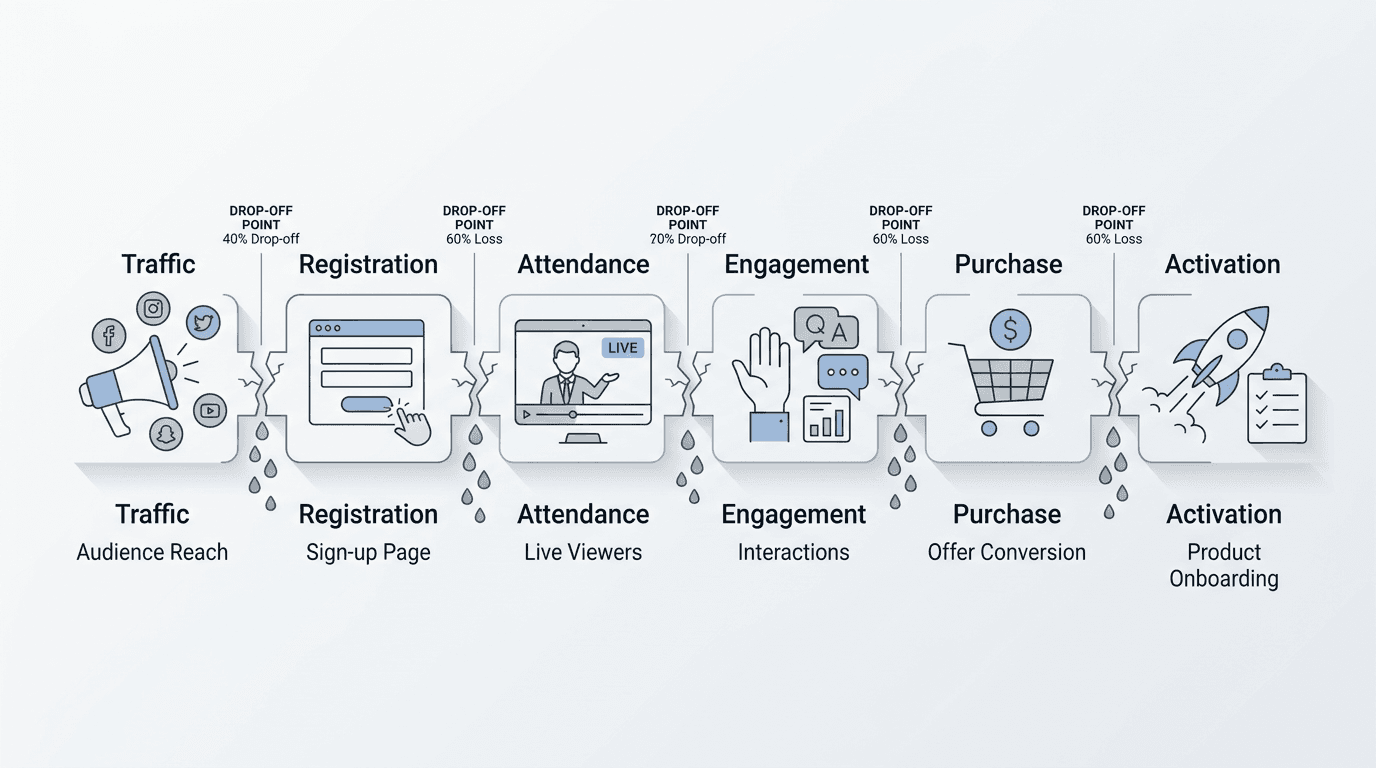
Why Webinar Funnels Fail for Most Course Creators (And It's Not Your Traffic)
Most webinar funnels fail not because of traffic, but because the transitions between stages of the webinar journey are broken. Learn how to diagnose leaks in the webinar revenue pathway.

Strategy
Why Most Course Businesses Don't Have a Traffic Problem
Most course businesses do not struggle because of traffic. They struggle because the pathway between stages of the student journey is incomplete. When the transitions between discovery, enrollment, engagement, and retention are not intentionally designed, revenue becomes unpredictable even if traffic is steady.

Strategy
The Hidden Revenue Between Course and Membership
How to design the transition most course creators leave to chance — and the recurring revenue it unlocks